

Getting chandelier sizes right can make or break a room. Too small and the fitting looks like an afterthought lost in the ceiling; too large and it crowds the space and pulls every eye in the wrong direction.
Choosing a chandelier that's genuinely well-matched to your room height, ceiling clearance, and furniture takes a bit of planning, but the payoff is worth it.
Chandeliers in 2026 come in 4 common size categories:
- Small chandeliers (25-45 cm diameter)
- Medium chandeliers (45-65 cm diameter)
- Large chandeliers (65-90 cm diameter)
- Extra large / grand chandeliers (90 cm+ diameter)
There are 6 common chandelier shapes and styles:
- Crystal / tiered
- Drum / shade
- Linear / island
- Globe / cluster
- Empire / candelabra
- Sputnik / geometric
Below is a guide on the most common chandelier sizes, dimensions, shapes, and materials.
This guide covers everything you need to know about chandelier sizes in 2026, including the formulas, standard dimensions, common styles, hanging heights, and materials used across Australian homes.
| Size Category | Diameter (cm) | Fixture Height (cm) | Weight (kg) | Best Suited For |
|---|---|---|---|---|
| Small | 25-45 cm | 20-45 cm | 2-8 kg | Bedrooms, bathrooms, breakfast nooks, small hallways |
| Medium Most Common | 45-65 cm | 40-70 cm | 5-20 kg | Dining rooms, living rooms, standard entryways |
| Large | 65-90 cm | 60-100 cm | 15-40 kg | Open-plan living, large dining areas, spacious foyers |
| Extra Large / Grand | 90 cm+ | 90-200+ cm | 30-100+ kg | Double-height entries, stairwells, void spaces |
All dimensions in centimetres and kilograms. Diameter refers to the widest point of the fixture body. Fixture height excludes chain/rod suspension.
Chandelier Size Categories Compared
Small Chandelier Sizes & Dimensions
Small chandeliers typically range from 25 to 45 cm in diameter, with a fixture body height of around 20 to 45 cm. They're a smart choice for bedrooms, bathrooms, smaller hallways, breakfast nooks, and any room with a standard 2.4 m ceiling.
A lot of Australian homes, particularly those built before the 1990s, come with ceilings in the 2.4 to 2.7 m range, and a small chandelier keeps proportions balanced without overwhelming the space. A 3 m x 3 m bedroom or a compact entryway is perfect territory for a 30 to 40 cm crystal or candelabra-style fitting.
| Dimension | Typical Range | Notes |
|---|---|---|
| Diameter | 25-45 cm | Suited to rooms up to ~3 m x 3 m |
| Fixture height (body) | 20-45 cm | Excluding chain or rod length |
| Weight | 2-8 kg | Standard ceiling rose fixings suitable |
| Chain / rod drop | 30-60 cm adjustable | Adjust to achieve correct hanging height |
| Clearance from floor | Min. 210 cm | Australian standard for walk-under areas |

Medium Chandelier Sizes & Dimensions
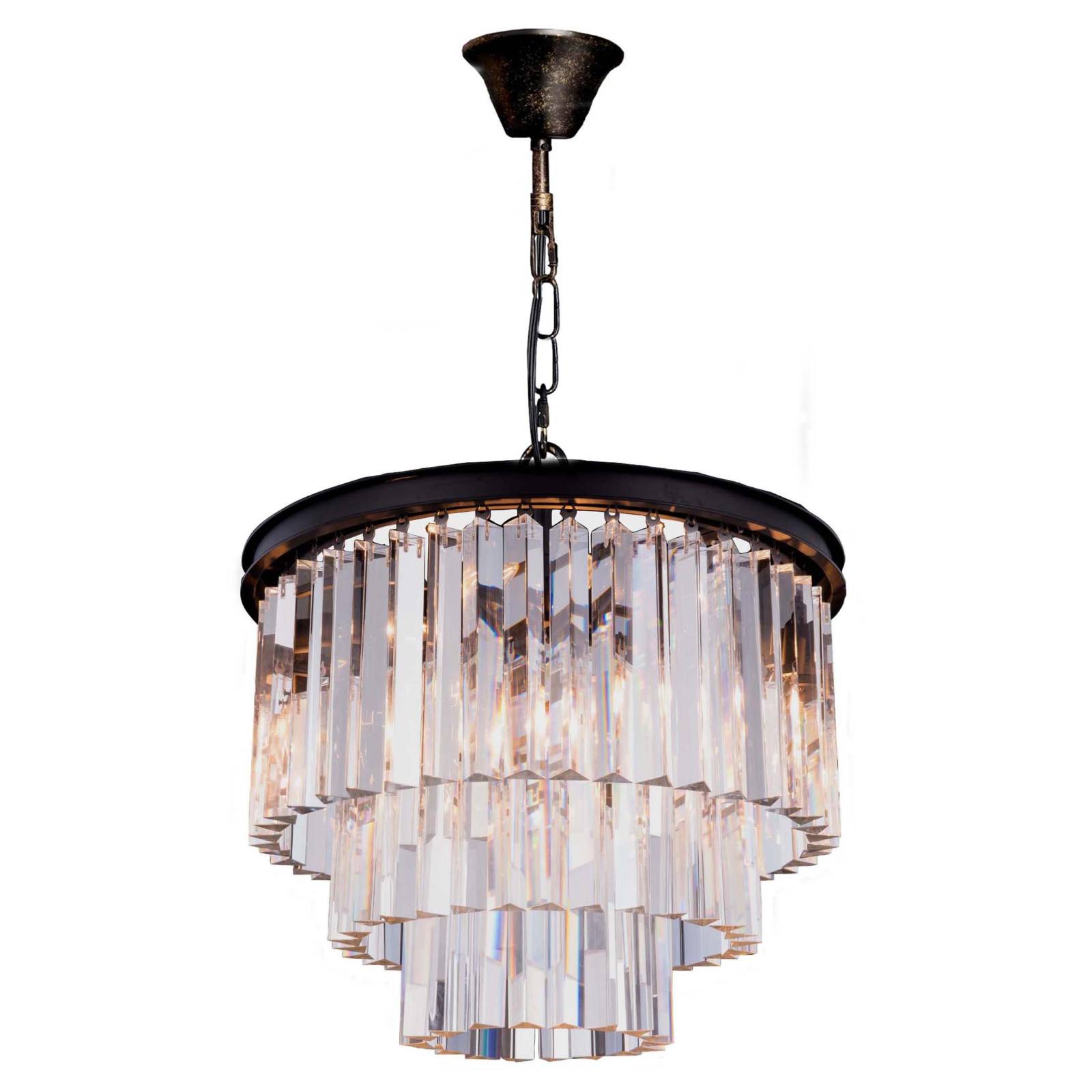
The medium chandelier is the most commonly purchased size in Australian homes. Spanning roughly 45 to 65 cm in diameter with a fixture body of 40 to 70 cm high.
Medium chandeliers suit standard dining rooms, living areas, and entryways - builds with 2.7 m ceilings. If you're hanging above a dining table, a medium chandelier in the 50 to 60 cm range pairs well with a standard 4 to 6 seater dining table (roughly 90 to 150 cm wide).
Most of the crystal chandeliers in the Schots range, including the Classique and Odeon collections, sit squarely in this category.
| Dimension | Typical Range | Notes |
|---|---|---|
| Diameter | 45-65 cm | Most versatile size for Australian homes |
| Fixture height (body) | 40-70 cm | Excluding chain or rod |
| Weight | 5-20 kg | May require braced ceiling rose for heavier end |
| Chain / rod drop | 40-80 cm adjustable | Schots Classique range: 50 cm chain standard |
| Height above dining table Key Rule | 75-90 cm | Fat Shack Vintage (Aus) recommends 75-90 cm above tabletop |
| Height above floor (walk-under) | Min. 210 cm | General Australian standard for clearance |
Large Chandelier Sizes & Dimensions
Large chandeliers range from about 65 to 90 cm in diameter and suit open-plan living areas, grand dining rooms, and spacious foyers in homes with 2.7 to 3.6 m ceilings.
In Australian homes with high ceilings and open-plan kitchens and dining spaces a large chandelier is often the right call to anchor the room and define a focal point. At this size, the fixture body height can range from 60 to 100 cm, which means ceiling height matters a lot for keeping adequate floor clearance.
Extra Large Chandelier Sizes & Dimensions
Extra large or grand chandeliers measure 90 cm and above in diameter, with fixture heights that can reach 200 cm or more on multi-tier or elongated void designs. These are built for double-height entries, open stairwells, and architecturally dramatic spaces.
In Australia, voids over staircases and double-height living areas are common in prestige builds across acreage properties and coastal homes, and an oversized chandelier is often the only fitting that can properly fill the vertical scale.
At this size, weight is a genuine structural consideration, with grand crystal chandeliers commonly weighing 30 to 100 kg or more, and professional installation with reinforced ceiling fixings is essential.
| Dimension | Typical Range | Notes |
|---|---|---|
| Diameter | 90 cm-180 cm+ | Match to void or room floor area |
| Fixture height (body) | 90-200+ cm | Can span multiple storeys in stairwell designs |
| Weight Important | 30-100+ kg | Requires braced ceiling box or structural engineer assessment |
| Ceiling height recommended | 3.6 m+ | At least 2.4 m clearance from floor to chandelier bottom |
| Chain / winch drop | Variable - often 1-4 m | Winch systems available for voids over 4 m |
Common Chandelier Shapes & Styles
The shape you choose affects not just aesthetics but how the fixture reads in your room, how heavy it is, and how much space it needs around it.
| Style | Typical Diameter (cm) | Typical Height (cm) | Weight (kg) | Best Room Fit |
|---|---|---|---|---|
| Crystal / Tiered | 30-120 cm | 40-200 cm | 5-100+ kg | Dining, foyer, formal living, stairwells |
| Drum / Shade Versatile | 40-90 cm | 35-60 cm | 4-18 kg | Bedrooms, living rooms, low ceilings |
| Linear / Island | 60-180 cm (length) | 20-40 cm | 5-25 kg | Kitchen islands, long dining tables, open-plan |
| Globe / Cluster | 30-80 cm | 30-70 cm | 4-20 kg | Dining, entry, contemporary living |
| Empire / Candelabra | 40-100 cm | 50-120 cm | 6-40 kg | Formal dining, foyer, heritage homes |
| Sputnik / Geometric | 40-100 cm | 30-80 cm | 3-15 kg | Contemporary living, bedrooms, modern entryways |
All dimensions in centimetres and kilograms. Linear chandelier diameter refers to total length. Weights are typical ranges; individual products vary.
Additional Chandelier Sizing Considerations
- Minimum floor clearance:
For any chandelier hanging in a walk-under area the bottom of the fixture should be no lower than 210 cm from the finished floor. Most Australian homes have standard ceiling heights of 2.4 to 2.7 m, so accurate chain/rod adjustment is important. Always account for the total drop (chain + fixture body height) before purchasing.
- Above dining tables - hang lower than you think:
The dining table is one of the few places where you can go lower than the standard 210 cm floor clearance, because no one walks directly beneath it. A height of 75 to 90 cm above the tabletop is the widely recommended range across Australian lighting retailers. If your ceiling is 2.4 m and your table height is 75 cm, that leaves 165 cm - divide by 2 to find the midpoint (82.5 cm), which aligns with this rule of thumb used by Designer Chandelier Australia.
- Weight and ceiling fixings:
Chandeliers over 10 kg require a braced electrical ceiling box, not a standard drywall rose. Grand and extra-large crystal chandeliers can exceed 50 kg, and a structural engineer assessment may be required before installation. This is particularly relevant in Queensland Queenslander homes, older Victorian-era terrace ceilings, and lightweight steel-frame construction, where ceiling joists may not support heavy fittings without reinforcement.
- Ceiling height and fixture height together:
When calculating whether a chandelier will fit, add the chain/rod drop length to the fixture body height, then subtract from your ceiling height to confirm floor clearance. A chandelier with a 60 cm body and 50 cm chain drops 110 cm from the ceiling- in a 2.7 m room, that puts the bottom at 160 cm, which is too low for a walk-under space. Adjust the chain length first, or choose a shorter fixture.
- Dining table width proportions:
For a chandelier above a dining table, aim for a diameter that is roughly 50 to 65 per cent of the table's width. For a standard 90 cm wide table, that means a chandelier in the 45 to 60 cm range. For a wider 150 cm table, consider 75 to 100 cm. The chandelier edge should always sit at least 30 cm inside the table edge on all sides so guests don't bump into it when sitting down.
| Location | Min. Floor Clearance | Hanging Height Rule | Notes |
|---|---|---|---|
| Above dining table | 75-90 cm above tabletop | Not walk-under; can hang lower | Centre over table, not room |
| Living room / open plan Key | Min. 210 cm from floor | Bottom of fixture at min. 210 cm | Standard for walk-under areas in Aus homes |
| Entryway / foyer | Min. 210 cm | Centre in space; eye-level impact | Two-storey: hang at second floor eye level |
| Stairwell / void | Min. 210 cm above stairs | Centred vertically in the void | Winch system recommended for high voids |
| Bedroom (above bed) | Not walk-under; can hang lower | Clear of bed head; check waking-up clearance | Aim for fixture bottom at approx. 180 cm above mattress |
Common Chandelier Materials
The material of a chandelier affects far more than its appearance. Weight, durability in Australia's varied climates, maintenance requirements, and how the fixture affects the size and installation method are all tied to the materials used.
Crystal chandelier and glass remain the most popular choice for traditional chandeliers in Australia, while metal frames dominate contemporary and sputnik-style designs.
Here's a practical breakdown of the main materials and what they mean for sizing and placement decisions.
Crystal and Glass
Lead crystal offers superior clarity and light refraction compared to acrylic alternatives. Heavier multi-tier crystal designs can weigh anywhere from 15 kg to well over 100 kg for grand statement pieces.
- Exceptional light refraction - creates prismatic effects across the room
- Available in small to grand sizes; the most versatile for scale
- Timeless style suits both heritage and contemporary Australian interiors
- Can increase perceived room brightness in south-facing rooms
- Heavier pieces (15-100+ kg) require braced ceiling fixings
- Multi-tier designs add significant fixture height - check total drop carefully
- Regular dusting required; not ideal for high-humidity Queensland bathrooms without IP-rated fittings
Metal (Steel, Brass, Chrome, Bronze)
Metal frames are used in the majority of contemporary chandeliers, from sputnik starburst designs to drum-shade and geometric styles. Steel and aluminium frames keep weight down significantly - most mid-size metal chandeliers weigh between 3 and 15 kg - which makes them easier to install and gives more flexibility on ceiling fixings.
Brass and bronze finishes add warmth; chrome and matte black suit modern interiors. In coastal Australian homes, powder-coated or lacquered metal finishes are recommended for salt-air resistance.
- Lightweight (3-15 kg for most designs) - easier installation on standard ceiling roses
- Wide range of finishes suit all Australian interior styles
- Sputnik and geometric styles add drama without significant fixture height
- Powder-coated options resist coastal humidity and salt air
- Open-frame sputnik designs can feel visually busy in small rooms
- Chrome finishes show fingerprints; requires regular polishing
- Less heat retention than crystal - purely decorative in terms of warmth
Fabric Shade (Drum Chandeliers)
Drum chandeliers use a cylindrical fabric or linen shade to house multiple bulbs and diffuse light softly downward. They tend to be the most compact in overall drop height (35-60 cm body height), which makes them a smart choice for rooms with lower 2.4 m ceilings where a tiered crystal design would be impractical.
Fabric shades can show water marks in humid climates, so choose breathable, non-porous fabrics in tropical or coastal settings.
- Compact body height (35-60 cm) suits standard 2.4 m ceilings well
- Diffused, warm light - ideal for bedrooms and lounge areas
- Lightweight (4-18 kg); most are suitable for standard ceiling roses
- Fabric can yellow or collect dust; not suited to high-humidity spaces without care
- Less dramatic visual impact compared to crystal or sputnik designs
- Shade diameter can appear larger visually than the stated measurement suggests
For formal dining rooms and grand entryways in traditional or heritage-style Australian homes, crystal and tiered designs are hard to beat. Contemporary open-plan spaces and Hamptons-style coastal homes suit metal globe or drum styles that keep visual weight low. Where ceiling height is limited to 2.4 m, prioritise shorter drum or compact sputnik designs over tall tiered chandeliers.
Top 7 Tips for How to Choose the Right Chandelier Size and Style
Getting the size right before you shop saves a lot of trouble. Here are the most useful things to check before you commit.
-
Measure the room before you look at chandeliers.
Write down the room length and width in metres, then add those numbers together and multiply by 10 to get your suggested chandelier diameter in centimetres. This formula is the most widely used starting point in Australian and international lighting design. It's a guide, not a rule - rooms with high ceilings, strong architectural features, or a specific focal point may benefit from going slightly larger. -
Calculate the total drop, not just the fixture size.
The total drop from ceiling to the bottom of the chandelier includes the chain or rod length plus the fixture body height. Add these together, subtract from your ceiling height, and confirm you have at least 210 cm of clearance in walk-under areas. A 2.4 m ceiling with a 70 cm body and 50 cm chain gives you only 120 cm to the bottom - far too low for a living room. -
Over a dining table, use the table width as your guide.
Choose a chandelier diameter that sits between 50 and 65 per cent of the table's width. For a standard Australian dining table of 90 to 100 cm wide, that puts you in the 45 to 65 cm chandelier range. The chandelier edge should stay at least 30 cm inside the table edge - so no one clips it getting in and out of their chair. -
Check the ceiling can take the weight before you order.
Any chandelier over roughly 10 kg requires a braced ceiling box - a standard plasterboard rose is not rated for heavier fixtures. For grand crystal chandeliers over 30 kg, have a licensed electrician assess the ceiling structure before purchasing. In older Federation or Queenslander homes, ceiling joists may be positioned differently to modern builds, so this step is especially important. -
In rooms with ceilings under 2.4 m, go flush or semi-flush.
If your ceiling is 2.4 m or below, a hanging chandelier with any significant drop will likely feel cramped and fail the clearance rule. Flush-mount and semi-flush chandeliers are designed for low ceilings and can still deliver the crystal or decorative drama you're after, just without the drop length. The Schots Celestial range includes flush-mount options specifically for this situation. -
Match the chandelier style to the architecture, not just the decor.
A heavily ornamented crystal tiered chandelier can feel at home in a Federation-era Melbourne terrace or a formal Queenslander dining room, but can compete awkwardly with the clean lines of a contemporary coastal home. Conversely, a minimalist sputnik or drum style can feel underwhelming in a period room with ornate cornicing. Think about the ceiling height, crown moulding, and overall architectural character of the room as well as the furniture. -
Don't forget the chain length is adjustable - use it.
Most chandeliers come with excess chain that can be shortened at installation. Before confirming a purchase, check what chain length is included and whether extension chain is available - this matters particularly for double-height spaces and stairwells. Schots stocks chandelier chain separately, and some grand models can be fitted with winch systems for ease of maintenance and bulb replacement at height.
Shop Chandeliers at Schots
Here are four chandelier options from Schots to suit a range of room sizes and styles.
Single Pendant Chandelier
- Compact, elegant profile ideal for bedrooms, hallways, and reading corners
- Minimalist single-arm design with timeless decorative detailing
- Available in satin brass, matte black, and chrome finishes
- Dimmable, 240v, IP20, wired to Australian standards
Multi Arm Pendant Chandeliers
- Striking multi-arm design ideal for dining rooms, entryways, and open-plan living spaces
- Classic chandelier styling with balanced proportions and decorative detailing
- Available in satin brass, antique bronze, matte black, and chrome finishes
- Dimmable, 240v, IP20, wired to Australian standards
Wall Mounted Chandeliers
- Space-saving decorative lighting ideal for hallways, bedrooms, and feature walls
- Elegant wall-mounted chandelier design with classic crystal detailing
- Available in satin brass, chrome, and matte black finishes
- Dimmable, 240v, IP20, wired to Australian standards
Antler Chandeliers
- Statement rustic lighting perfect for vaulted ceilings and large living areas
- Natural antler-inspired silhouette with warm ambient illumination
- Available in resin antler, timber-look, and matte black finishes
- Dimmable, 240v, IP20, wired to Australian standards
Choosing the right chandelier size comes down to measuring your space carefully, matching the diameter to the room or table dimensions, and accounting for the total drop before committing to a fitting.
Complete your space with the right proportions and styling by exploring our helpful furniture sizing guides;
Dining Table Size Guide
Coffee Table Sizes Guide
Dining Chair Sizes Guide
These guides will help you create a balanced and functional interior space for your home.
Browse the full chandelier collection at Schots, or explore the complete lighting range to find the perfect fit for your home.


